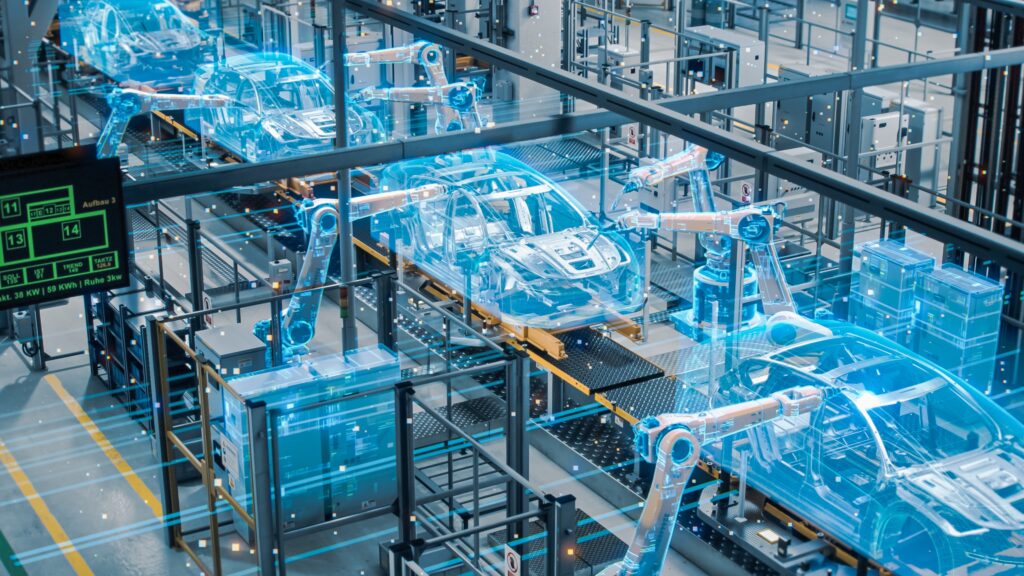
Explore how industrial robotics revolutionizes manufacturing by achieving unparalleled precision, consistency, and reliability, significantly boosting production quality.
Key Takeaways:
- Industrial robotics eliminates human error, leading to consistently high-quality products.
- Robots perform repetitive tasks with extreme precision, reducing defects and waste.
- Advanced sensors and vision systems enable robots to inspect products in real-time.
- Data generated by industrial robotics allows for continuous process optimization.
- The adoption of industrial robotics leads to higher product reliability and customer satisfaction.
The Precision Advantage: How Industrial Robotics Minimates Defects
In the realm of modern manufacturing, quality is paramount. It underpins brand reputation, customer satisfaction, and ultimately, profitability. One of the most significant advancements in achieving superior production quality has been the widespread adoption of industrial robotics. Unlike human operators, who are susceptible to fatigue, distraction, and the inherent variability of manual dexterity, robots offer unwavering precision and repeatability.
Consider a task like welding or assembly. A human welder, even highly skilled, will exhibit slight variations in bead width, penetration, or angle over a long shift. An industrial robot, once programmed, will execute that same weld with micrometric accuracy, thousands of times consecutively, without deviation. This consistency is not just about speed; it’s fundamentally about eliminating the primary sources of defects that plague manual production lines. From automotive body assembly in the US to intricate electronics manufacturing, industrial robotics sets a new standard for precision, directly translating into a dramatic reduction in product defects and a boost in overall output quality.
Ensuring Consistency: The Role of Industrial Robotics in Repeatable Processes
Consistency is the backbone of high-quality mass production. Consumers expect every product they purchase to meet the same exacting standards, whether it’s the first item off the line or the millionth. Achieving this level of uniformity manually is exceedingly difficult and resource-intensive. This is precisely where industrial robotics shines, offering an unmatched ability to perform repetitive tasks with perfect consistency.
Think about pick-and-place operations in electronics, applying adhesive, or precise painting. A robot’s arm moves along an identical path, applies the same force, and executes the task in the same amount of time every single cycle. This eliminates variations that can lead to misaligned components, inconsistent finishes, or improper bonding—all factors that degrade product quality. The ability of industrial robotics to replicate exact movements, without drift or error, ensures that each product leaving the factory floor adheres to the same stringent quality specifications, fostering reliability and trust in the brand. This repeatability is a cornerstone of modern manufacturing excellence.
Advanced Quality Control Through Industrial Robotics and Vision Systems
Beyond simply performing tasks with precision, many modern industrial robotics systems are equipped with advanced sensor technology and integrated vision systems, turning them into powerful quality control agents. These robotic eyes and touch sensors can perform real-time inspections that surpass human capabilities in speed and accuracy.
For example, a robot assembling circuit boards can use its vision system to verify the correct placement and orientation of every tiny component before soldering. If a discrepancy is detected, the robot can either correct it or flag the defective item for removal, preventing it from moving further down the production line. Similarly, robots can perform intricate measurements, check for surface imperfections, or test functionality with a level of detail and speed impossible for human inspectors. This proactive, in-line quality verification capability of industrial robotics catches defects earlier in the process, minimizing waste, reducing rework, and ensuring that only products meeting the highest standards reach the end-user.
Data-Driven Improvement: Industrial Robotics and Continuous Quality Optimization
The deployment of industrial robotics doesn’t just improve quality through precision and consistency; it also generates a wealth of data that can be used for continuous process optimization. Robots are connected systems, constantly recording parameters such as cycle times, force applied, temperatures, and error rates. This data is invaluable for identifying trends, pinpointing inefficiencies, and proactively addressing potential quality issues.
By analyzing the data collected from industrial robotics, manufacturers can:
- Predict maintenance needs: Preventing breakdowns that could lead to inconsistent production.
- Identify root causes of defects: If a specific robot task shows a higher error rate, the data can help pinpoint why, allowing for reprogramming or recalibration.
- Optimize process parameters: Fine-tune speeds, forces, or temperatures to achieve even better quality and efficiency.
This data-driven approach to quality management transforms manufacturing from a reactive “fix-it-when-it-breaks” model to a proactive “prevent-it-from-happening” system. Companies in the US and globally are leveraging this intelligence from their industrial robotics deployments to not just maintain, but continuously raise their production quality standards, leading to higher customer satisfaction and a stronger competitive edge.